
Bilingual children's books tell a story in two languages. The languages can sit side by side or mix within the story. For preschool nursery rhymes, start with Los pollitos / Little chickies. Señorita Mariposa offers nature stories, while Todos Iguales / All Equal suits older readers interested in history.
After the short English–Spanish reading list, you'll find a practical example of adapting a story you own the rights to. It starts with a bedtime sentence and ends with a copy you can read in both languages. The example covers the EPUB file, a digital book format, and illustrations. It also covers wording that sounds natural when read aloud.
How two languages fit into one children's book
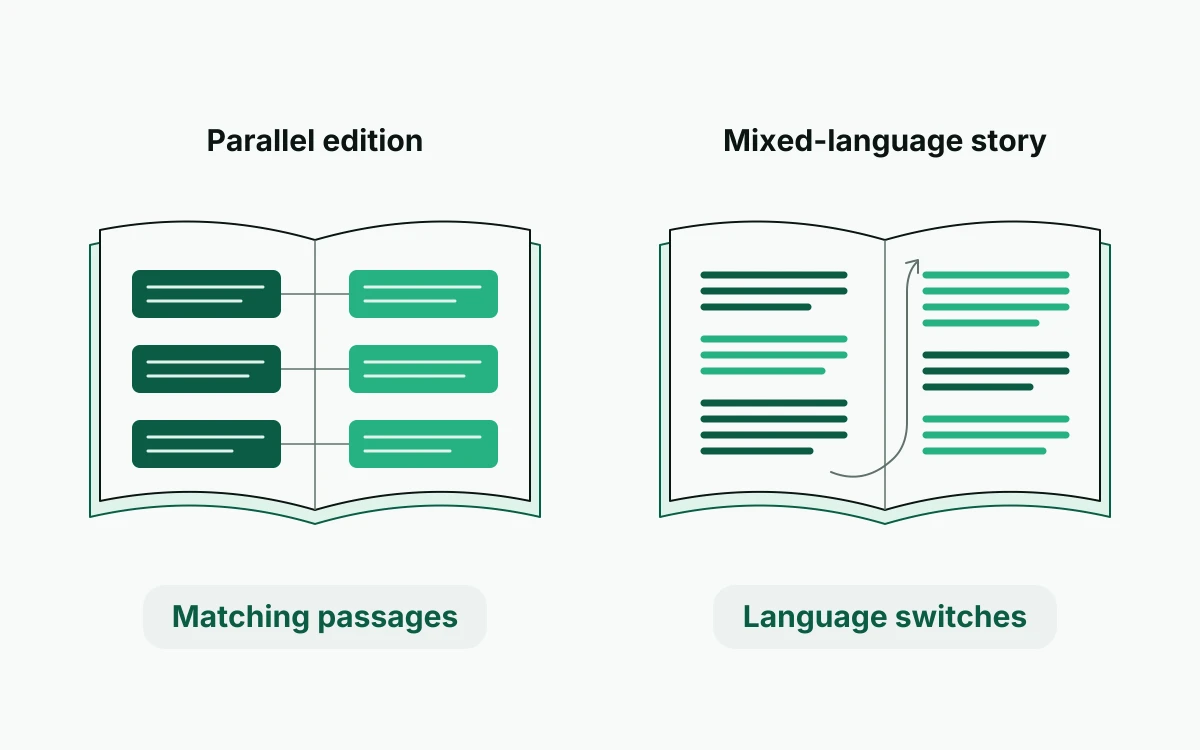
A parallel edition puts matching passages in two languages together. You can find the same moment in either language. A mixed-language story needn’t translate every line. Switching between languages can be part of its rhythm.
For example, Gato guapo was written by Anika Aldamuy Denise and illustrated by Zara Gonzalez Hoang. It combines counting with a musical blend of Spanish and English. Reading that blend feels different from reading matching translations side by side.
The file format affects the editing, too. In a reflowable EPUB, text moves when you change the font size. Passages stacked one above the other can suit a narrow screen. Fixed illustrated pages, including PDF pages, keep words beside particular pictures. Adding a translation may mean moving text or pictures to keep a reveal on the right page.
The right tool depends on the job, whether it is free or paid:
- General translation engines and chatbots help translate passages and suggest other ways to word them.
- Browser extensions, tools added to your browser, are best suited to reading webpages.
- Desktop converters, programs on your computer, help change file formats, such as PDF to EPUB. Picture-book layouts need checking afterward.
- Whole-book translators suit chapter-by-chapter work where names and terms appear again.
A paid tool may still be a poor fit for your story’s layout.
Six English–Spanish books worth starting with
Match the book to what your child already enjoys: rhymes, letters, animals, family stories or history. These six English–Spanish titles range from preschool read-alouds to books for longer talks about history.
- For preschool rhymes: Los pollitos / Little chickies. This nursery-rhyme book uses both languages and is based on “Los Pollitos Dicen.” It suits a child who likes hearing familiar lines again. It works well for sharing rhymes, with less focus on a longer story.
- For alphabet exploration: A-Ztec: A Bilingual Alphabet Book, by Emmanuel Valtierra. It suits ages 4–8. The book focuses on the alphabet in two languages. It fits a child who prefers letters to a story that runs from start to finish.
- For nature stories: Señorita Mariposa. English and Spanish text follows monarch butterflies on their yearly trip from Canada to Mexico. A child who likes butterflies or nature may enjoy this one. It also suits children curious about migration, the move animals make from one place to another.
- For animal poetry: Flutter and Hum / Aleteo y Zumbido, by Julie Paschkis. Animal poems and artwork offer a different reading pace from a book with one storyline. It suits a child who enjoys animals and short pieces you can pause over or revisit.
- For immigration and wordplay: Mamá the Alien. A girl reads “alien” on her mother’s Resident Alien card and thinks of another planet. Her mistake opens a talk about immigration, or moving to another country to live. It also helps you discuss how one word can have different meanings.
- For history: Todos Iguales / All Equal. Listed for ages 8–12, this Spanish–English book tells the story of the 1931 Lemon Grove school desegregation case. The case concerned ending the practice of keeping children apart in school because of their background. It suits a reader ready to talk about schools and fairness through a real event in history.
For French, Chinese or Italian, check that the edition has the exact two languages you want before ordering. The listed languages and sample pages should show that both appear inside the same book.
Prepare one story for a bilingual reading copy
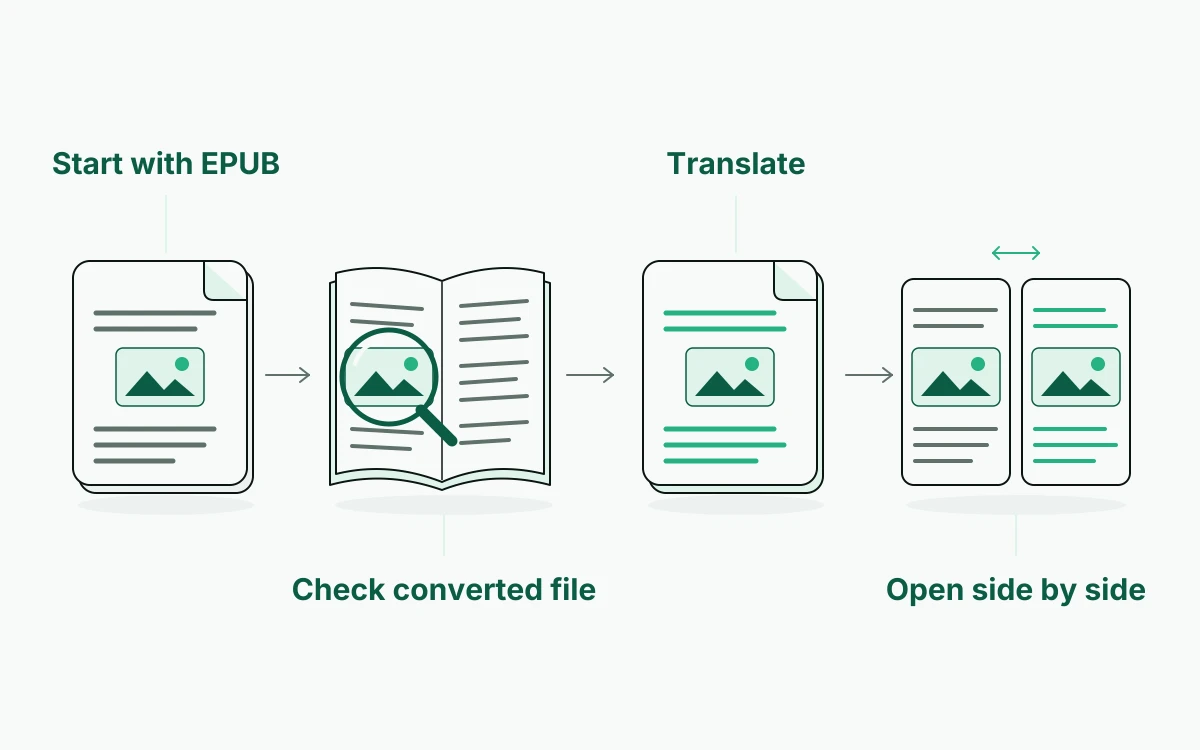
Start with an EPUB, an ebook file, and translate it into the language you want. Then open the original and translation side by side. For an illustrated story, check the converted file before translating.
- Buying a copy does not by itself give you permission to publish a translation. Use your own work, a work in the public domain or material whose licence permits translation; otherwise, ask the rights holder. Rules for private use vary by jurisdiction.
- For your bedtime story, start with a manuscript you can edit or an existing EPUB, if available. Either is a better starting point than a PDF, a file with fixed page layouts.
- DualBook’s free converters turn PDF, MOBI (another ebook format) or Word files into EPUB files for translation. For example,
bedtime-story.docxbecomesbedtime-story.epub. - Check that the EPUB’s chapters are in order and its pictures are in the right places. Each picture should still sit beside the right passage. Converting a file can change picture-book layouts, especially when you start with a PDF.
- Choose Spanish as the language to translate this English bedtime story into.
- Translate the story. DualBook translates whole EPUB books chapter by chapter, keeping names and terms consistent.
- Open paired reading to see matching paragraphs side by side or stacked one above the other.
A bedtime sentence in English and Spanish
A bilingual adaptation tells the same story moment in two languages. This draft example comes from moon-rabbit.epub, an invented bedtime story owned by its author. It is neither a published excerpt nor a tested translation result.
English: “The little rabbit whispered, ‘Good night, Moon.’”
Spanish: “El conejito susurró: «Buenas noches, Luna».”
“Conejito” gives “little rabbit” a short, warm sound. The Spanish punctuation changes, but the quiet action stays the same.
Machine translation can struggle with names that are also ordinary words. Here, the rabbit speaks to “Moon” as someone. “Luna” should stay a name rather than become the ordinary “la luna.” A glossary, a list of terms and their translations, makes that choice clear with Moon → Luna.
Check these details before reading aloud or publishing
Use the file you plan to share for these final checks.
- Open the converted EPUB, your ebook file, on the device you plan to use. Look for cropped pictures, missing captions and pictures separated from their scenes. Words inside images, such as signs or speech bubbles, may still be in the original language.
- Wordplay needs a closer look at the words around it. Machine translation can read “I’m all ears” as a reference to body parts rather than attention. In Spanish, “Te escucho” conveys “I’m listening”; a word-for-word translation could accidentally give your rabbit extra ears.
- Reading both languages aloud helps you catch stiff dialogue and awkward pauses. Keep the illustration visible to check that both versions match the pictured action. In the rabbit scene, both sentences should sit beside the same rabbit-and-moon illustration. Check names and glossary terms throughout the story, including the earlier choice of “Luna.”
- Translated sentences may take more space. Check longer text for cramped captions, separated paragraph pairs and words covering artwork. This check matters especially when you change the font size.
- Before publication, an editor who knows both languages should review the meaning and voice. They should also approve the final page proofs, which show how the finished pages will look. Publishing requires an edition prepared for publication, with both languages side by side or stacked.