For adult learners, easy books to read in English for beginners pair clear language with a story worth following. A1 and A2 learners usually do best starting with graded readers, while learners around B1 or above can try short original novels such as The Giver, Animal Farm or Of Mice and Men. The right pick depends on the vocabulary, sentence structure, dialogue and subject, and on what you actually enjoy reading.
What this list of easy English books covers
The list starts with graded readers for A1 and A2 beginners and moves on to original books for beginner to intermediate learners. Every title has fairly clear language, short sentences, brief chapters or a story that’s easy to keep track of. The notes point out what helps learners in each book, and also the dialogue, themes or cultural context that can make it harder.
Reading a whole book in English helps your vocabulary, reading and writing, listening and speaking, confidence and empathy. The most useful book isn’t simply the easiest one, though: it also has to be interesting enough to keep you turning pages.
True beginners at A1 or A2 often find an unadapted novel frustrating. At those levels graded readers are usually the better start, because publishers adapt the grammar and vocabulary for language learners. Series from Oxford Graded Readers, Cambridge Readers and Penguin Readers give you an alternative to full, unadapted novels.
If you’re torn between simplified and original texts, compare graded readers and authentic books first. The original novels below usually become realistic around B1 or above, though the right starting point varies from reader to reader.
How We Chose These Books
The titles come from recommendations written for English language students and for beginning or intermediate learners. We favoured books those sources describe as having simple vocabulary, clear prose, short sentences, brief chapters, a short overall length or an easy-to-follow story.
We also looked at what can make a simple-looking novel hard. Informal contractions, slang, emotionally intense subjects and unfamiliar cultural settings can need some preparation even when the sentences are straightforward, so each book’s note names its particular hurdles instead of hiding them behind one difficulty label.
Interest counts as much as readability. A mystery, a dystopia, a family story and a social novel will each pull in different readers, and extensive reading works best when you can understand the text and want to know what happens next. The difference between extensive and intensive reading helps you decide when to read straight through and when to stop for detailed study.
The books, from graded readers to original novels
At A1 or A2, start with the graded readers. They use simplified grammar and vocabulary, while the original books further down bring bigger challenges such as slang, dialect, political ideas, cultural context or emotionally difficult subjects.
A1 and A2 Graded Readers for Beginners
These four adapted books give true beginners a clear place to start. Their controlled language and short stories suit A1 and A2 learners far better than the unadapted novels later in the list.
-
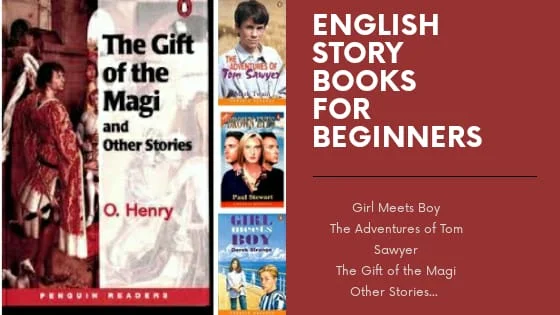
Girl Meets Boy
This A1/A2 graded reader follows Donna and Mark on a trip to Spain. It’s a simple romance told in the present tense, full of everyday vocabulary, basic descriptions and the kind of conversation you’d have while travelling.
-
Brown Eyes
A short A1/A2 mystery with very simple vocabulary and brief chapters. The suspense gives adult beginners a reason to keep going while they practise basic question forms and everyday expressions.
-
The Wizard of Oz
This A1/A2 graded version follows Dorothy, the Scarecrow, the Tin Man and the Cowardly Lion on their way to meet the Wizard. Short sentences and simplified language let beginners practise directions, basic adjectives and the vocabulary of friendship.
-
The Gift of the Magi and Other Stories
An A2 collection of short stories, including the one about a husband and wife who each sell a treasured possession to buy the other a gift. The short format suits learners who want stories with feeling without taking on a full unadapted novel.
Original Books for Stronger Beginners and Intermediate Learners
The seven books below are unadapted. Most are better starting points for B1 or intermediate learners, although some sources recommend particular titles to beginners because they’re short or their sentences are easy to read.
Clear Language and Short Chapters
Short chapters or compact sections give you regular places to stop and make progress easy to see. The three books in this group use direct prose or a simple structure, though their social themes and unfamiliar ideas still take some attention.
-
The Curious Incident of the Dog in the Night-Time by Mark Haddon
The mystery starts when Christopher finds that a neighbor’s dog has been killed and decides to investigate. The story is told from Christopher’s point of view, and his logical, direct explanations give the novel a plain style English learners can follow.
It’s recommended for beginning to intermediate learners because it pairs simple vocabulary and grammar with short chapters. The comedy and the mystery keep you reading, while Christopher’s experiences raise questions about communication, relationships and autism.
-
The House on Mango Street by Sandra Cisneros
Instead of one long, conventional story, this book follows Esperanza Cordero through short chapters, or vignettes, about growing up in Chicago. Sandra Cisneros writes in fairly simple language with short sentences.
Each short section is a natural stopping point for learners who can’t yet manage a long reading session. The book also deals with gender, poverty, race and life in a Latina community, so many readers meet experiences different from their own.
-
The Giver by Lois Lowry
Jonas lives in a society that seems ideal: there’s no war or hunger, and no real choice either. Once he’s given his life assignment as the Receiver, he starts to discover what the community hides.
Short sentences and simple language make the main story easy to follow, and the dystopian setting gives intermediate learners room to build vocabulary. It was written for young adults, but it has proved popular with older language students too, so adult learners shouldn’t pass it over because of its original audience.
Short Classics with Accessible Prose
Short classics give you manageable prose without limiting you to simple themes. Animal Farm and Of Mice and Men are both brief and direct; what makes them harder is political allegory in the first and nonstandard dialogue in the second.
-
Animal Farm by George Orwell
Farm animals rebel against Mr. Jones in this short allegory about dictatorship and Communist Russia. The plot is simple, and the political meaning gives adult readers plenty to think about beyond the surface story.
George Orwell is known for clear, accessible writing. The novel is recommended for intermediate learners and comes as an audiobook and an ebook. You can follow the direct prose before you’ve unpicked every layer of the allegory, so it works to read for the events first and come back to the politics afterwards.
-
Of Mice and Men by John Steinbeck
George Milton and Lennie Small travel through California looking for ranch work during the Great Depression. It’s a short, gripping story about loneliness, mostly in fairly simple language, and library staff recommend its easy-to-read sentences for beginning English learners.
The dialogue is the main challenge. Forms like “ain't,” “gonna,” “wanta” and “why'n't” look nothing like standard written English, so going over these contractions before you start saves a lot of confusion. An audiobook also helps you hear how the dialogue differs from the narration.
Contemporary Themes and Young Adult Stories
Young adult fiction works well for adult learners when the prose is clear and the subject holds your interest. The Outsiders uses short sentences and teenage conflict, while Refugee Boy pairs accessible language with a heavier story about war and displacement.
-
The Outsiders by S. E. Hinton
Teenage characters, rival groups and growing up drive this novel, told in short sentences and fairly simple language. S. E. Hinton wrote it in the 1960s, yet its teenage worries still connect with students in many countries.
It has worked especially well with teenagers and young adults. Adult learners who like character conflict and a young point of view may find its direct style easy to get into, while someone looking for a story about adult life may prefer another title.
-
Refugee Boy by Benjamin Zephaniah
Alem is a fourteen-year-old boy with an Ethiopian father and an Eritrean mother. Because the two countries are at war, his family is welcome in neither, and he eventually arrives in Great Britain as a refugee.
Benjamin Zephaniah writes in a simple, clear style that learners around B1 and above can understand, though the subject is heavier than the language. The book shows how complicated a refugee’s life is and opens up discussion about displacement and empathy, which makes it a strong choice for adult learners who want easy prose and a serious theme.
The books compared at a glance
Which book is easiest depends on where the difficulty comes from. Short chapters and sentences lighten the language load, but slang, nonstandard contractions, political allegory, cultural context or an intense subject can still slow you down. The table shows each book’s suggested starting level, what helps and what’s hardest.
| Book | Suggested starting point | Helpful feature | Possible challenge |
|---|---|---|---|
| Girl Meets Boy | A1/A2 | Everyday vocabulary and present tense | Simple relationship misunderstandings |
| Brown Eyes | A1/A2 | Very simple vocabulary and short chapters | Following mystery clues |
| The Wizard of Oz | A1/A2 | Short sentences and simplified language | Fantasy vocabulary |
| The Gift of the Magi and Other Stories | A2 | Short, self-contained stories | Emotional vocabulary and twist endings |
| The Curious Incident of the Dog in the Night-Time | Beginner to intermediate | Short chapters and direct explanations | Unfamiliar perspective and social themes |
| The House on Mango Street | Intermediate | Short vignettes and sentences | Cultural and social themes |
| The Giver | Intermediate | Simple language and a clear central story | Dystopian vocabulary and ideas |
| Animal Farm | Intermediate | Short length and accessible prose | Political allegory |
| Of Mice and Men | Beginner | Short story with easy-to-read sentences | Nonstandard contractions in dialogue |
| The Outsiders | Teen and young adult learners | Short sentences and familiar youth themes | Informal teenage language |
| Refugee Boy | B1 and above | Simple, clear style | Emotionally difficult subject |
The levels and reading features in the table come from the beginner storybook guide, the School for Training’s classroom recommendations and the Palo Alto City Library staff list. Treat them as guidance, not formal test results.
How to Choose Your First English Book
Match the Book to Your Level
Look for manageable language and a subject you care about. A1 and A2 learners can start with Girl Meets Boy, Brown Eyes or The Wizard of Oz, and learners ready for short stories at A2 can try The Gift of the Magi and Other Stories. At B1, a short original novel with clear sentences may be within reach. At B2 or above, take on more unadapted fiction, keeping an eye out for slang, dialect and culturally specific words.
Begin with the kind of story you already enjoy. Mystery readers may prefer The Curious Incident of the Dog in the Night-Time; readers drawn to society and political power may get more out of Animal Farm or The Giver; and if you like realistic social themes, start with The House on Mango Street, Of Mice and Men or Refugee Boy.
Check What Makes the Book Difficult
Difficulty isn’t only about individual words. Of Mice and Men uses mostly simple language, but its contractions can slow you down, and Animal Farm has clear sentences carrying difficult ideas. A short book isn’t automatically an easy one, and books written for young adults can still offer adult readers real substance.
If you can follow the main events without translating every sentence, keep reading. Constant dictionary use breaks up the story and drains motivation, and these techniques for reading English books without translating help you live with unfamiliar words while following the bigger picture.
Use Audio for Spoken English
Audio helps when a novel is full of conversational English; listening while you follow the text can make the contractions in Of Mice and Men much clearer. The library list offers several titles as audiobooks or ebooks, including Animal Farm, The Giver and The Curious Incident of the Dog in the Night-Time, and this practical guide to reading with English audiobooks explains how to combine the two.
Switch books when the level is clearly wrong. Struggling through a novel you can’t understand is discouraging, and moving to a graded version or a shorter, clearer book is simply how you keep reading until authentic fiction feels comfortable.
Frequently Asked Questions
Beginner readers usually want to know whether to start with a graded reader or an original novel, whether books for younger readers are worth their time, and how much vocabulary they need. The short answer: pick an interesting text at a level you can manage, and switch formats if an unadapted novel turns out to be too hard.
What English book should a beginner read first?
A true beginner at A1 or A2 should start with a graded reader such as Girl Meets Boy, Brown Eyes or The Wizard of Oz. At A2, The Gift of the Magi and Other Stories offers shorter reads with emotional depth. If you can already follow simple original prose, Of Mice and Men is worth a try, as long as you go over its informal contractions first, since the dialogue is far less standard than the narration.
Are children's and young adult books useful for adult learners?
Yes. A book written for younger readers can still suit an adult language learner. The Giver was written for young adults and has also been popular with older students: its short sentences and simple language make it easy to follow, and its dystopian society raises serious ideas about freedom, choice and control.
Should beginners read graded readers or original novels?
A1 and A2 learners are generally better off with graded readers, which adapt grammar and vocabulary for language learners. Original novels become a realistic option around B1 or above, chosen with care. If you can’t understand enough of the story to stay interested, the graded edition is the practical choice.
Is it useful to listen to an audiobook while reading?
It helps most when the dialogue is full of unfamiliar contractions or spoken forms, and the library list notes audiobook versions for several of the novels here. Following the printed text while you listen shows how the written sentences sound, without changing the story.
Do I need to understand every word in an English novel?
No. What matters is following the main events and staying interested, not knowing every word before you start. If unfamiliar vocabulary stops you following the story, choose an easier text or a graded edition; if the story stays clear, keep reading and let context do the work instead of stopping at every new word.
Pick one book that fits your level and your interests, then give it a short, regular reading slot to see whether its language and story suit you.